Liquid Phase Granular Activated Carbon (GAC) Vessels
H2K manufactures industrial carbon filters for removal of benzene (BTEX), naphthalene, MTBE, TCE/PCE, and other dissolved VOCs.
 General Description
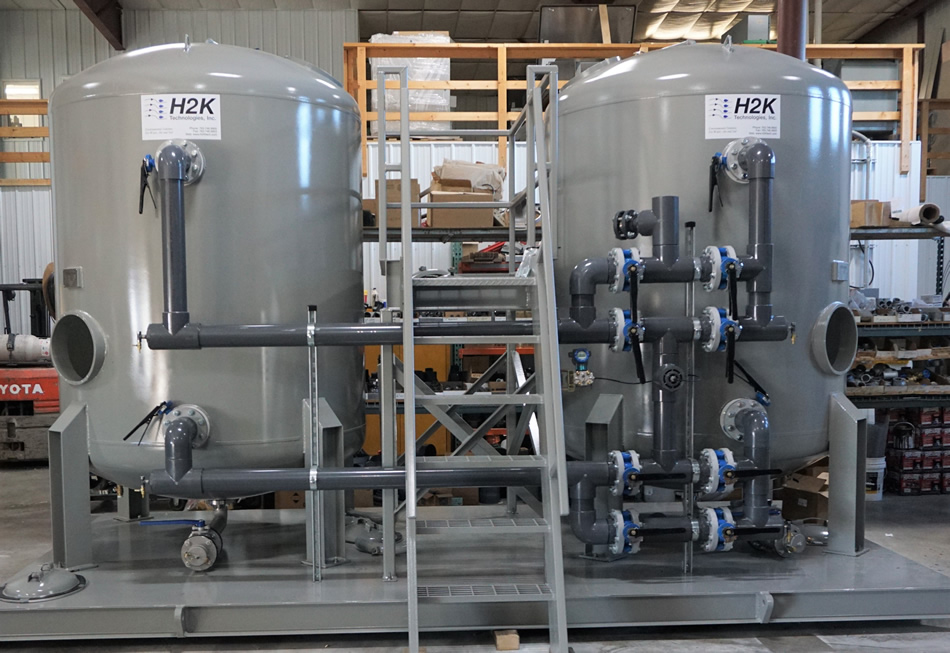
Carbon filters are used in water treatment for removal of dissolved organic compounds from contaminated water sources. LGAC vessels are used for treatment of ground water, storm water, municipal water and wastewater treatment. Activated carbon media uses an array of pores for dissolved organic removal. Contaminated water is processed through vessels filled with granular activated carbon to adsorb contaminants. Dissolved organic compounds are caught in pores on the carbon surface and removed from the process flow.
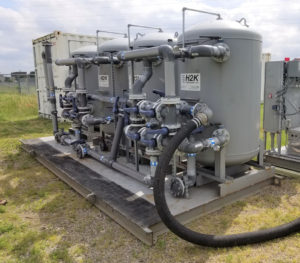
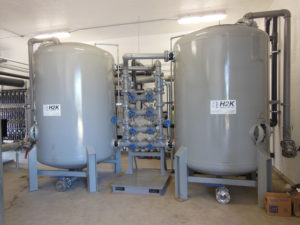
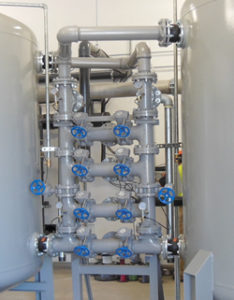
Activated carbon in a LGAC filter has a finite lifespan before it breaks through and allows contaminants to pass through the filter. Carbon vessels are typically installed in a lead/lag series orientation to prevent contaminant discharge. Once carbon is spent in the lead vessel, it is replaced with fresh carbon and the orientation of the vessels is switched via a valve header. The former lag vessel becomes the new lead vessel and vice versa after media changeout. This configuration helps utilize the carbon adsorption capacity as efficiently as possible.
Typical Treatment Applications
|
|
|
GAC Only
GAC or Air Stripping
|
 |
Design Considerations
H2K manufactures carbon vessels with many design options to accommodate a large variety of water treatment applications. We provide performance modeling to determine carbon filter sizing and bed life based on provided sampling data. Water flow rate, contaminants & concentrations, discharge pressure, and discharge criteria are all factors in carbon vessel design.
Contaminants & concentrations: LGAC vessels provide satisfactory adsorption performance when water has sufficient residence time to adsorb contaminants in carbon. Water residence time in a carbon vessel is commonly referred to as Empty Bed Contact Time (EBCT). Larger diameter vessels will provide longer EBCT for a given water treatment system. Generally, larger contaminants will use up media more quickly and require more frequent carbon change-outs.
Process flow rate: Vessel sizing must properly balance flow rate and carbon capacity to avoid over or under sizing the vessels. Increasing flow rate through a carbon filter results in quicker carbon consumption and increased filter pressure drop. Oversized vessels can cause distribution issues that result in carbon channeling and early contaminant breakthrough.
Discharge criteria: Depending on the destination of treated water, different types and grades of activated carbon are available for use. A high quality regenerated activated carbon is commonly used in applications with non-potable industrial discharge locations while virgin activated carbon is required in potable water applications. Our carbon modeling considers all the parameters to determine a recommended filter size, carbon quantity and predicted carbon bed life.
Design Options Available
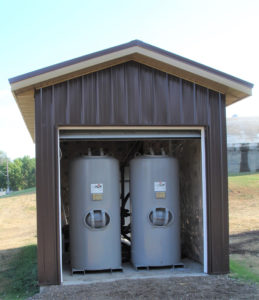
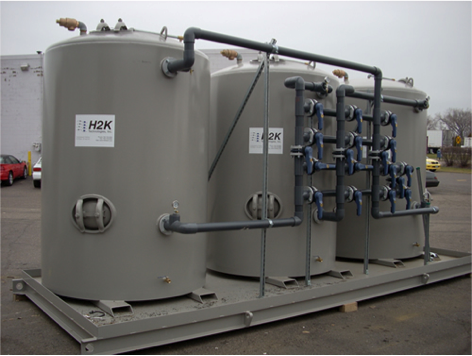
LC Series – H2K’s standard industrial carbon vessel line is rated for flows up to 400 GPM, with up to 10,000 Lbs. of carbon. Pressure ratings range from 45 – 75 psi
LCA Series – ASME – ASME stamped vessels, rated for flows up to 900 GPM, with up to 30,000 lb. carbon capacity are available with design ratings up to 150 psi.
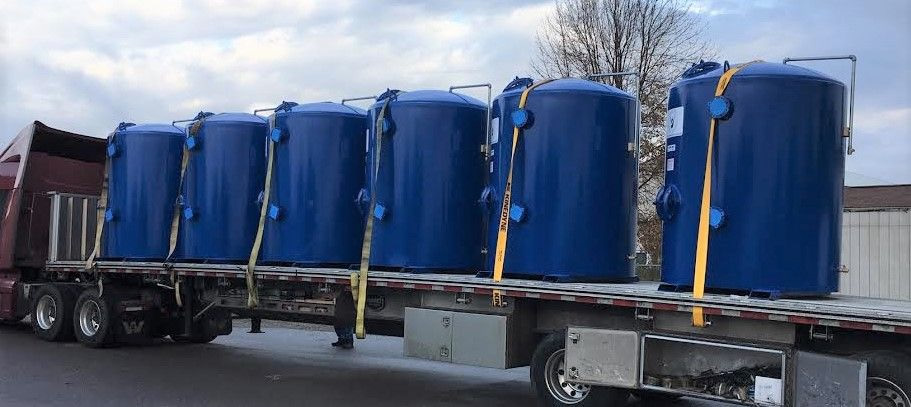
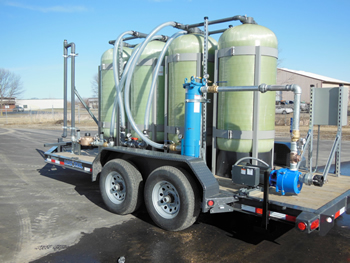
LCF Series – FRP – Fiberglass carbon vessels are lightweight and very portable. These filters can handle up to 120 GPM and hold up to 1,250 Lbs. of carbon.
Lead/lag and backwash piping headers – Carbon filters can be set-up with a PVC or steel valve header which allows easy toggling of lead and lag vessels. Carbon backwash headers are also available which allows reverse flow through the vessels to remove surface fouling from the carbon bed.
Transfer pumps and instrumentation – H2K Technologies offers a full line of centrifugal and positive displacement pumps to feed water through LGAC vessels. Safety switches and process transmitters are available if automation and telemetry are a desired part of your system.
Depending on concentration, flow and other water quality characteristics, pre-treatment options may be required in addition to GAC treatment. H2K Technologies offers supporting water treatment equipment to provide a turnkey treatment solution.
Multimedia Filtration – if high inorganic solids loading is present
Oil water separators – if free phase product is present
Project Examples
Portable carbon treatment system
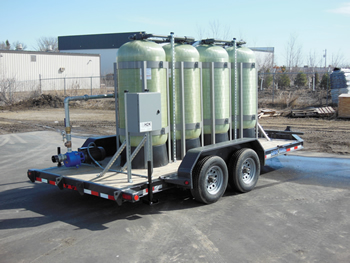
This project includes a portable carbon vessel trailer to treat multiple dewatering ponds. Activated carbon was used to treat benzene and gasoline range organics. H2K constructed a portable, easy to use fiberglass GAC assembly to effectively treat up to 100 GPM for sewer discharge.
Benzene carbon treatment
H2K Technologies supplied a turnkey water treatment system including ASME-stamped liquid phase carbon vessels. These vessels filtered 200 GPM for BTEX for discharge to sewer. The carbon filters feature a lead/lag piping header, carbon slurry lines for ease of carbon change-out, and backwash piping to mitigate fouling.
Rental Carbon Filters
H2K Technologies offers a large rental product line for emergency response, pilot testing, and construction dewatering applications. Vessels are available as single units or packaged skid complete with lead/lag piping and controls. Rental vessels are available in sizes up to 8’ diameter for flows up to 400 GPM.